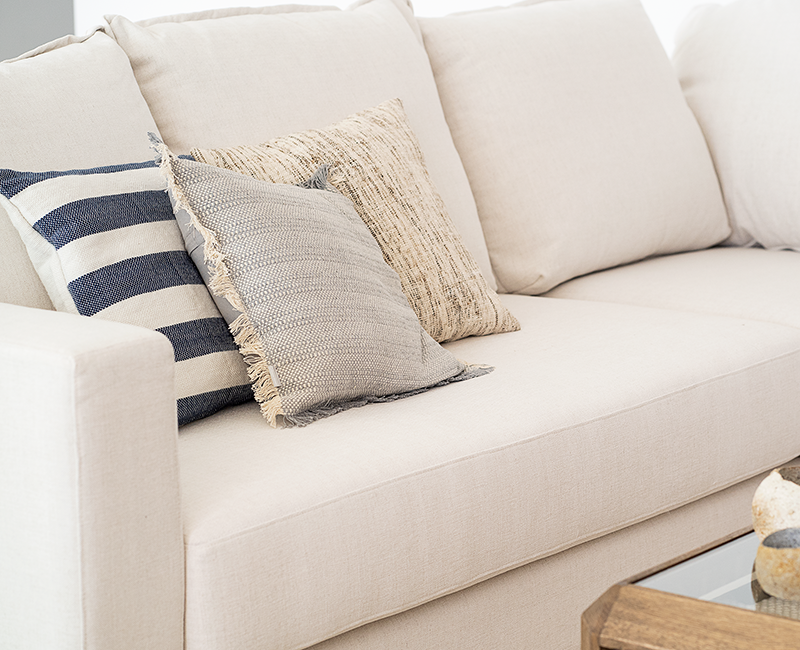
When a home is well considered, design moves beyond appearance and becomes part of everyday use. It is not about changing what already works, but about introducing decisions that subtly expand how the space is lived in.
These ideas focus on a level of design that reveals itself over time, through use, flow and the way the space supports different moments of the day.
1. Elements that organise without enclosing
Continuous benches, low furniture or open shelving help define different uses without compartmentalising the space. They provide support, storage and order while preserving visual continuity.
2. Shading systems as a spatial tool
Curtains, textile shades or lightweight panels do more than provide protection. They help create distinct zones and allow the space to be used more naturally, without relying on rigid solutions.
3. Multifunctional furniture
Pieces that can be sat on, moved or repositioned, such as benches, side tables or poufs, allow the space to adapt easily to different moments and numbers of people.
4. Strategic use of colour
Desaturated, mineral or natural tones help balance bright spaces and visually connect different areas without introducing strong contrasts.
5. Integrated, low-level lighting
Indirect light integrated into furniture or architectural elements makes it possible to use the space differently once the sun goes down, without depending on general lighting or visible fixtures.
A well-designed space does not seek attention. It is recognised in how easily it is used, in the sense of continuity between areas and in how naturally it supports daily life. That is when design stops being decorative and becomes part of the experience.